Bf 109F-4
What if Manfred von Richthofen had been at the controls of a Bf 109F-4? It would have been the ultimate intersection of World War I aerial gallantry and the peak of aeronautical elegance and agility—the hallmarks of the Friedrich series.
If Manfred von Richthofen, the famous Red Baron, had survived the First World War and remained active during the Second, his impact would likely have been political and strategic rather than that of an active fighter pilot on the front lines.

Born in 1892, Richthofen would have been around 47 years old at the start of WWII. At this age, an elite pilot of that era was already considered too old for direct dogfights. He would likely have held a high-ranking position in the Luftwaffe, possibly even in place of Hermann Göring. Historians speculate that his presence would have created a major rivalry with Göring, who was his subordinate in WWI. Richthofen was seen as a professional and calculated soldier, unlike Göring, whose leadership was often criticized for disastrous political and logistical decisions.
Richthofen was a brilliant tactician. Under his command, the Luftwaffe might have avoided major strategic blunders, such as the failure in the Battle of Britain, where German tactics remained rigid. Furthermore, although he was deeply tied to his Fokker Dr.I triplane, Richthofen was a proponent of technological innovation, which could have accelerated the development of German jet aircraft. In WWI, he was the most feared pilot, with 80 confirmed victories. The Nazis would have certainly used him as the ultimate symbol of the 'German hero.' However, Richthofen was a Prussian aristocrat with a strict code of honor; it is uncertain whether he would have embraced extremist ideology or if he would have clashed with the regime, as other career officers did. He would have clearly been an inspiration to the aces: the WWII generation (such as Erich Hartmann) would have had Richthofen as a direct mentor, boosting the morale of the German Air Force to unprecedented heights. While unusual, there were pilots like Theo Osterkamp who scored victories in both World Wars. In Germany’s desperate final moments of the war, it is possible the Baron might have climbed into a Messerschmitt Bf 109 or an Me 262 for one last mission, turning it into a legendary historical event, regardless of the outcome.
Manfred Meyer was an author and illustrator for many publications focusing on German aviation from WWII and the post-WWII era (such as Die Flugzeuge der DDR, etc.) during the 1990s.
The 'Red 4' profile he drew for Manfred Griehl's FLUGZEUG Profile No. 28: Messerschmitt Bf 109F is stated in that publication to represent an aircraft that flew in Sicily in 1943.
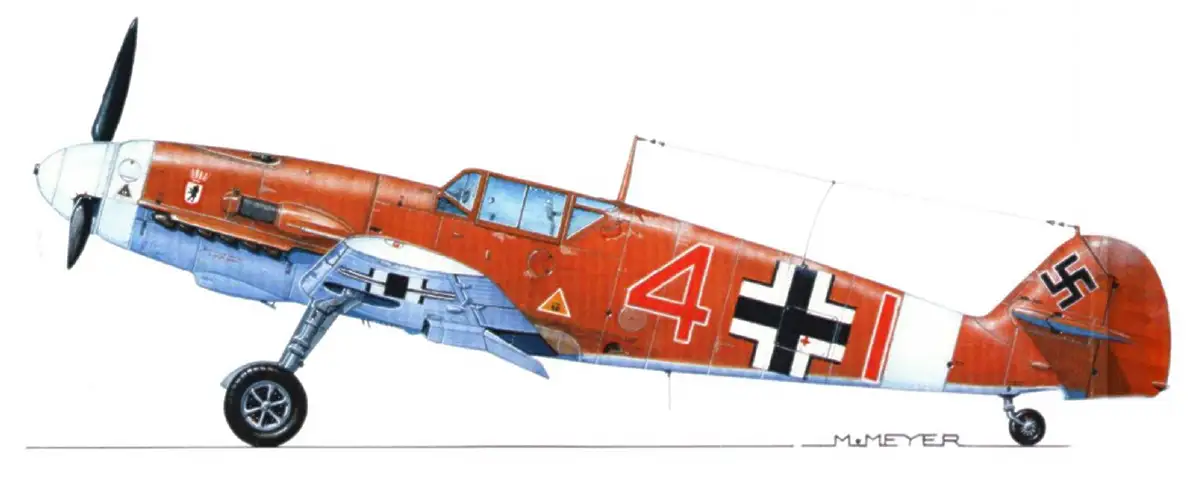 Supporters of the idea that the profile represents a real aircraft claim it was painted in red oxide primer during the hurried evacuation of Sicily in '43. Others argue that the aircraft was actually intended for testing within the Erprobungshilfe—Luftwaffe test and evaluation centers—which would account for the red color.
It must be said that there is no known evidence to support these claims (at least none that I have found)
The 'Red 4' profile, depicting a Bf 109F-4 in an all-red finish and situated in 1943 Sicily, has generated considerable debate due to its unconventional camouflage. Proponents of the scheme argue that the aircraft was finished solely in red oxide primer amidst the chaos of the Sicilian evacuation. Conversely, skeptics contend that the red livery is simply a flawed interpretation of monochromatic period imagery.
Personally, I don't believe either side because they aren't based on any kind of evidence—just tall tales. I don't believe in interpreting black-and-white photos; it's not as if there are 'correct' or 'incorrect' interpretations, even though some have turned it into a pseudo-science. I'll believe it when I show them a shade of gray with no context and they correctly tell me which color it corresponds to. In other words, never.
Regarding the opposing view, I don't buy the primer theory either. Based on my research, the Germans used red primer on aircraft only on rare occasions (in contrast to AFVs, where it was the standard). The primary aircraft primer was Zinkchromat-Grund, used until the later stages of the war when shortages forced a switch to cheaper alkyd or nitrocellulose-based primers containing iron oxide. 1943 is simply too early for that shift. To suggest they lacked the time for the topside camouflage, yet somehow found the time to finish the undersides and apply all those specific markings, is highly implausible.
The idea that this aircraft was painted in red primer because it was among the planes used by the Germans in aviation testing centers also seems hard to believe. Usually, prototypes and aircraft tested in these centers did not carry unit markings, but only identification codes and other markings necessary for testing purposes.
Therefore, I consider the historical accuracy of this profile to be non-existent. Regardless of the fact that it was illustrated by Manfred Meyer, or that older model kits popularized the idea of a red 109, these interpretations are likely nothing more than a romanticized 'what if' scenario—a fictional return of the Red Baron in a World War II setting
But that’s beside the point. Scale modeling is about so much more than cold historical accuracy. A red 109 is a breath of fresh air amidst the endless sea of traditional RLM schemes. At least from a modeler’s point of view
On another note, red 109s do exist. There was a prototype and even some later versions used at airshows and demonstrations in Switzerland and the USA. But none of them were used in combat in that color (we're no longer in WWI, when they would paint their planes in whatever wild color crossed their minds).
No matter which 1/48 Eduard kit you pick, the plastic parts are identical across all three. The variation lies in the decal options provided in each box. Specifically, the ProfiPACK edition (82114) offers masks and photo-etched details, plus a wider range of markings, which are not included in the Weekend Edition kits (84188 and 84146).


I opted for a white primer because I decided to do some pre-shading for the rivet lines and panel lines.


To achieve the right red, I went with a 50/50 mix of Mission Models Red Oxide and Atom Scarlet Red. In my experience, no single manufacturer gets the German iron oxide primer quite right—it’s either too brown or overly red. I kept the pre-shading subtle, keeping in mind that the contrast will appear sharper once the surface is glossed.


It took three coats of thinned red paint, mixed with TRANSPARATOR, to achieve the desired effect Transparator, diferența între straturi se vede mai jos


I didn't use decals for the aircraft markings. Everything was done using self-made masks and then airbrushed.


